
Is a single-height Armco barrier sufficient for your site, or do you need a double, triple or four-high system?
Choosing the right configuration depends on more than the overall Armco barrier height. You need to consider the vehicles using the area, how they move, what needs protecting and what could happen if an impact occurs.
This guide explains how the different configurations work, when each may be appropriate and why more than one type of barrier may be needed across the same site. For guidance on the height at which individual beams can be installed, read our Armco barrier height guide.
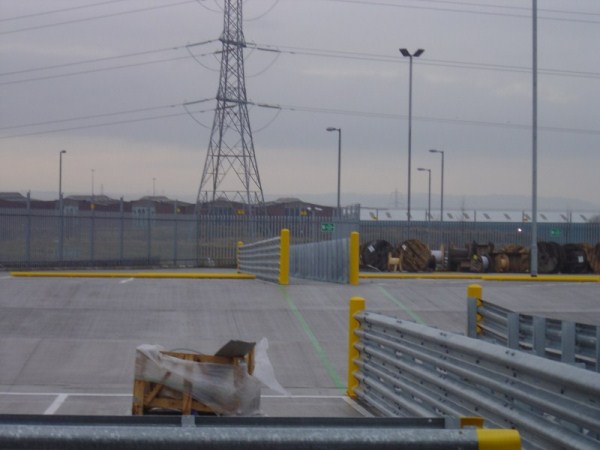
Triple-height Armco barriers at the Co-operative Distribution Centre in Motherwell.
What do single, double, triple and four-high Armco barriers mean?
The difference between these configurations is straightforward:
- Single-height Armco barriers have one horizontal beam
- Double-height Armco barriers have two horizontal beams installed one above the other
- Triple-height Armco barriers have three beams
- Four-high Armco barriers have four beams
Adding steel beams increases the vertical area covered by the barrier. This can help protect higher parts of machinery, structures or other assets that could remain exposed above a single beam.
However, adding more beams does not automatically make a barrier the best, or safest, option.
The system must still be suited to the risks in that particular area. Vehicle type, approach angle, speed, traffic movement, ground conditions and the asset being protected can all influence the final specification. The right barrier is one that provides suitable protection in the right place.
When should you choose each Armco barrier configuration?
Different barrier configurations are suited to different layouts and protection requirements. The following examples provide a useful starting point, but every site should be assessed individually.
Single-height Armco barriers
A single-height system provides lower-level impact protection that may be suitable for car park boundaries, perimeter edges and other areas used mainly by cars or smaller site vehicles. It can also be used to separate vehicle routes from structures or equipment where the main impact risk is at a relatively low level.
Single-height Armco barriers are limited by the amount of vertical coverage they can provide. Depending on the position of the beam, higher parts of a vehicle or asset may remain exposed. Where risk still exists, a barrier system with more vertical coverage may be necessary.
Double-height Armco barriers
A double-height Armco barrier uses two beams installed one above the other. The second beam extends the protected area vertically, helping the system cover a larger part of the potential impact zone.
This arrangement may be considered where taller vehicles or machinery operate, or where the asset being protected extends above the coverage provided by one beam. It can also be useful in areas where vehicles of different heights use the same route or the potential point of impact varies.
At the Crossrail depot in London, CT Safety Barriers installed double-height Armco barriers to protect people and assets from moving vehicles and machinery. The wider project included several different safety systems because the risks and protection requirements varied throughout the depot.
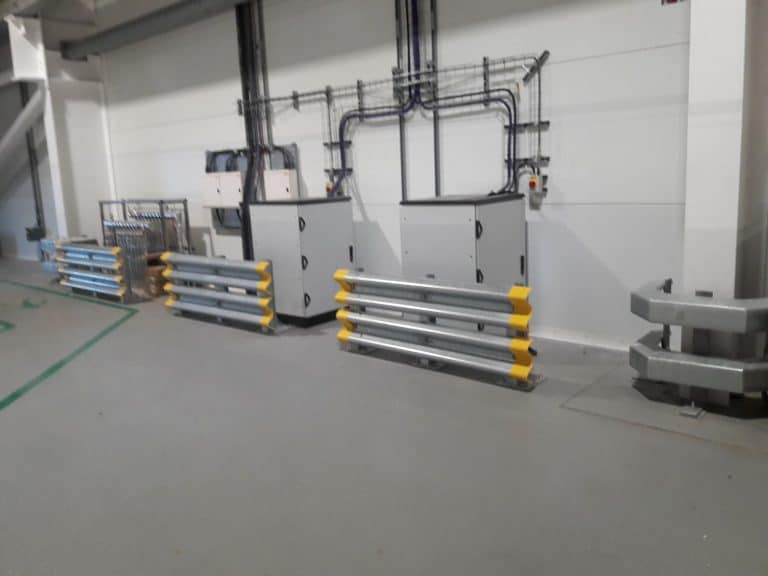
Double-height Armco barriers installed by CT Safety Barriers at the London Crossrail Depot
Triple-height Armco barriers
Triple-height barriers use three beams to extend protection further upwards.
They may be considered where a single or double-height barrier would leave too much of the risk area exposed. This could include parts of a distribution centre, depot or industrial building used by tall vehicles, trailers or handling equipment.
CT Safety Barriers designed, manufactured and installed safety products for both the internal and external areas of the Co-operative Distribution Centre site in Motherwell. The project included single, double and triple-height Armco barriers, with each configuration used to address the risks in a different area.
Four-high Armco barriers
Four-high Armco barriers provide the greatest vertical coverage of the four configurations discussed in this guide.
They are generally used for specialist applications or where a large vertical area must be shielded from workplace vehicles or machinery.
This may include important structural sections of a building or assets that extend well above the level protected by a standard single or double-height system.
CT Safety Barriers installed four-high Armco barriers at the Crossrail depot in London to protect the structural integrity of the building from vehicles and machinery. The installation required careful calculations to establish the barrier requirements. The systems were manufactured at CT Safety Barriers’ Yorkshire production facility.
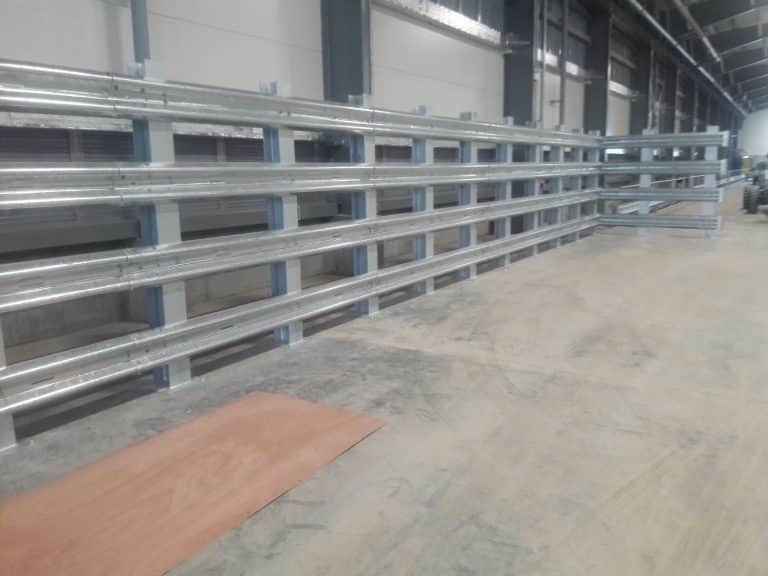
Four-high Armco barriers installed by CT Safety Barriers at the London Crossrail Depot
Can one site use different Armco barrier heights?
Yes. In many cases, using one standard configuration across an entire site would not reflect how the risks change from one area to another.
Vehicle types, traffic routes and the assets being protected can vary considerably across a warehouse, depot or distribution centre. A car park boundary may only need lower-level protection, while a loading area or internal vehicle route may need two or three beams.
The appropriate configuration can also change based on:
- Turning circles
- Reversing areas
- Loading bays
- Doorways and entrances
- Pedestrian routes
- Building corners
- Structural columns
- Machinery and service equipment
At the Co-operative Distribution Centre, single, double and triple-height barriers were installed across the same site, with each configuration serving a different purpose.
This mixed approach allows protection to follow the actual site risks. It avoids under-specifying higher-risk areas while also avoiding unnecessary complexity where one beam provides suitable coverage.
What else affects the final Armco barrier specification?
The question is not simply, “What Armco barrier height does this site need?” It is, “What needs protecting in this part of the site, and where could a vehicle make contact?” The number of beams is only one part of the complete system.
A suitable specification may also depend on:
- Post type: Different Armco barrier posts may be used depending on the level and type of vehicle activity.
- Fixing method: Bolt-down posts may be suitable for concrete surfaces, while cast-in posts may be required where bolting is not practical.
- Post spacing: The distance between posts affects the arrangement of system components.
- Corners: Standard or purpose-made corners may be required to follow the site layout.
- Barrier ends: End sections should be selected according to traffic and pedestrian exposure.
- Ground conditions: The existing surface and what lies beneath it can affect the fixing method.
- Available space: The barrier, posts and fixings must fit without creating another obstruction or reducing safe movement.
- Vehicle approach: Speed, direction, turning and reversing movements influence where protection is needed.
- Nearby pedestrians: Armco barriers may need to work alongside handrails, mesh or separate pedestrian protection.
There is no single Armco barrier configuration that suits every site. The right number of beams depends on the height of the area you need to protect, the vehicles operating nearby and how they move through the space.
For straightforward layouts, the calculator can help with initial planning. For more complex requirements, our team can help you confirm the most suitable configuration.
Plan your requirements with the Armco barrier calculator
The Armco barrier calculator is a useful starting point when planning a straightforward barrier run.
It includes options for barrier length, post type, leg type, post centres, ends, corners and beam type. It then produces an estimated component list, which can be submitted to the CT Safety Barriers team for further discussion.
The calculator is best suited to straightforward single and double-height Armco barrier systems. If your site requires triple-height, four-high or a combination of different configurations, speak to our team. We can review the layout and risks and help you specify the right arrangement.
For help confirming the correct Armco barrier configuration for your site, call CT Safety Barriers on (01977) 666 818 or send an email to sales@ctsafetybarriers.co.uk.