
HGVs regularly operate in warehouses, distribution centres and industrial yards, often in confined spaces alongside other vehicles, machinery and pedestrians.
Managing these movements safely is an important responsibility. An HGV collision can cause significant damage to buildings, loading bays and equipment, as well as putting employees and visitors at risk.
Safety barriers can help manage these risks by protecting vulnerable areas, separating pedestrians from vehicle routes and limiting damage caused by accidental impacts.

Crash barriers at the Cooperative Motherwell
What are the main HGV accident risks in warehouses and loading yards?
HGV movements create several risks in busy industrial environments, particularly where vehicles need to manoeuvre through confined spaces or operate close to buildings and pedestrians.
Some of the most common risks include:
- Wide turning circles and trailer swing: HGVs need considerable space to turn, and the rear of a trailer can swing towards nearby buildings, equipment or other vehicles during tight manoeuvres.
- Driver blind spots: Drivers may struggle to see pedestrians, smaller vehicles or obstacles close to their cab or trailer, particularly when turning or reversing.
- Reversing into loading bays: Positioning large vehicles accurately can be difficult, increasing the risk of collisions with loading bay structures, doors and surrounding equipment.
- Collisions with buildings and infrastructure: HGVs operating in confined spaces can accidentally strike walls, structural columns, building corners and other vulnerable parts of a site.
- Pedestrians moving around HGVs: Employees and visitors walking through loading yards or crossing vehicle routes may be at risk, particularly when HGVs are reversing or manoeuvring in areas with limited visibility.
The level of risk varies depending on the layout of the premises, the frequency of vehicle movements and the types of HGVs, but identifying these hazards is an important step in choosing suitable safety measures.
How can safety barriers help reduce HGV accidents?
Safety barriers help protect buildings, equipment and pedestrian areas from accidental vehicle contact. Depending on their design and installation, they can help to guide vehicles, separate people from traffic and reduce the consequences of accidental collisions.
Armco Barriers for buildings and infrastructure
Armco safety barriers are commonly used in industrial environments to protect buildings, walls, structural columns and other infrastructure from accidental vehicle impacts.
Armco barriers are made from corrugated steel sections supported by posts, creating a physical boundary between vehicle routes and vulnerable areas. They can also help to absorb and redirect some impact forces, depending on the barrier specification, installation and the nature of the collision.
Safety bollards for targeted protection
Bollards provide a more targeted form of protection around specific hazards. Rather than creating a continuous barrier along a vehicle route, bollards can be positioned individually or in groups to protect areas such as:
- Building corners and entrances
- Roller shutter doors and pedestrian doorways
- Exposed equipment and machinery
- Vulnerable structures close to vehicle routes
Wheel guides and stops for loading bays
Loading bays are particularly vulnerable to accidental vehicle contact because HGVs regularly need to reverse into precise positions. Wheel guides and stops can help drivers to position vehicles correctly.
- Wheel guides help guide HGVs and lorries into position when approaching a loading bay, reducing the likelihood of tyres moving outside the intended approach route.
- Wheel stops provide a physical positioning aid, helping to indicate or limit how far a vehicle should move in a particular area.
Neither of these products should be treated as a substitute for impact-resistant barriers or other loading bay safety systems. Their primary purpose is to guide or position vehicles, rather than to withstand significant HGV collisions.
Pedestrian barriers for separating people and vehicles
Where employees and visitors need to move around a busy yard, pedestrian safety barriers can help establish clearer boundaries between people and vehicle movements.
These barriers can be installed alongside designated walkways, around building entrances or in areas where pedestrians share space with moving HGVs.
However, pedestrian barriers are not always designed to withstand vehicle impacts. Where walkways are exposed to HGV movements, additional impact-resistant protection may be needed.
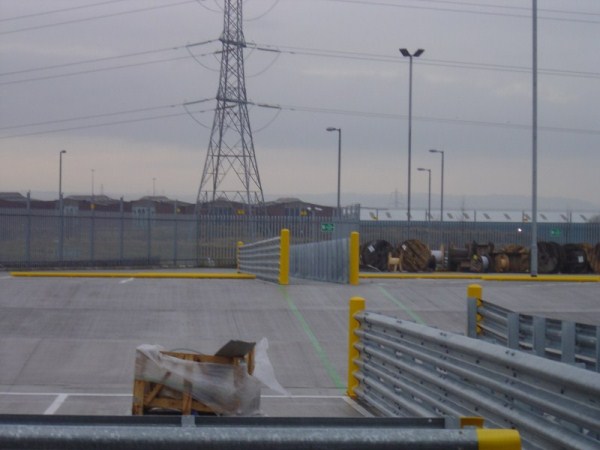
Triple-height Armco barriers at the Co-operative Distribution Centre in Motherwell.
What else can businesses do to improve HGV yard safety?
Safety barriers are an important part of managing vehicle risks, but they cannot prevent every accident. Businesses also need suitable traffic-management procedures to reduce the likelihood of collisions occurring in the first place.
Several practical measures can help improve safety around HGV routes and loading areas:
- Reduce reversing: Design vehicle routes to minimise reversing wherever practical, with designated reversing areas where necessary.
- Separate pedestrian and vehicle routes: Provide designated pedestrian walkways and clearly marked crossing points away from HGV manoeuvring areas.
- Introduce one-way systems: Use one-way routes where suitable to reduce conflicting vehicle movements and complicated manoeuvres.
- Control vehicle speeds: Set appropriate speed limits and use signage or traffic-calming measures to encourage safer driving.
- Maintain good lighting and signage: Keep vehicle routes, loading bays and potential hazards clearly visible in all operating conditions.
- Establish clear driver procedures: Provide clear instructions covering site access, loading and unloading, parking and pedestrian safety.
Where should HGV safety barriers be installed?
Safety barriers are commonly installed around loading bays, tight turns, building entrances, structural columns and pedestrian walkways. However, not every site will need protection in all these locations.
A large distribution centre with clearly separated vehicle routes may have different requirements from an older industrial site where HGVs need to manoeuvre around existing buildings and equipment.
The type of protection required can also vary within the same site. A continuous Armco barrier may be appropriate along one vehicle route, while individual bollards may provide a more practical option around a nearby doorway.
Before deciding where to install barriers, businesses should assess their existing vehicle movements, identify areas where collisions could occur and consider the potential consequences.
Choosing the right HGV safety barriers for your site
Choosing the right safety barriers involves more than picking a product and deciding where to install it. The protection needs to be appropriate for the vehicles using your premises, the risks involved and the conditions at your site.
There are several important factors to consider:
- Vehicle size and weight: Heavier vehicles generate greater impact forces, so barriers must be suitable for the types of HGVs using your site.
- Vehicle operating speeds: Higher speeds increase potential impact forces and may require more substantial protection.
- Turning space and vehicle movements: Barriers should protect vulnerable areas without restricting turning circles or creating additional hazards.
- Ground conditions: The ground or concrete surface must be suitable for the barrier’s foundations or fixings.
- Access requirements: Continuous barriers may suit exposed vehicle routes, while individual bollards can provide targeted protection where access is needed.
- Impact resistance: Check that the barrier’s specification and installation are suitable for the potential vehicle impacts identified in your site risk assessment.
Protect your site with the right HGV safety barriers
HGV movements are an essential part of many warehouse and industrial operations, but they also introduce risks that need to be managed carefully.
Safety barriers can help protect buildings, equipment and pedestrians by creating physical separation and reducing the consequences of accidental vehicle impacts.
At CT Safety Barriers, we manufacture Armco barriers and safety products from our Yorkshire facility, helping businesses protect vulnerable areas across industrial and commercial premises.
Looking to improve HGV safety at your site?
Call us on (01977) 666 818 or send an email to sales@ctsafetybarriers.co.uk.